
Efficient Management of Sample Reception and Documentation at the Croatian Veterinary Institute, Zagreb, Croatia

Darko Želježić*

Abstract
The reception office at the Croatian Veterinary Institute plays a crucial role in ensuring the accurate and efficient handling of samples and accompanying documentation, and serves as the first point of contact for veterinarians and inspectors regarding samples, or for clients who call by phone. This paper outlines the best practices for managing sample reception, emphasising the importance of proper documentation, the use of technology to streamline processes, and the implementation of quality control measures. Proper documentation is essential for maintaining sample traceability and integrity, which is critical for accurate testing and analysis. The use of technology, such as electronic documentation systems and barcode scanning, can significantly enhance the efficiency and accuracy of the sample reception process. Additionally, implementing quality control measures, including regular audits and staff training, ensures the reliability and consistency of the reception process. By adopting these best practices, the Croatian Veterinary Institute can improve its operational efficiency and reduce the risk of errors, thereby contributing to public health and safety.
Key words: sample reception; documentation; Croatian Veterinary Institute; quality control; technology
Introduction
The Croatian Veterinary Institute, Zagreb, Croatia is responsible for conducting various tests and analyses on animal samples to ensure public health and safety. These tests are crucial for detecting diseases, monitoring animal health, and ensuring the safety of animal products for human consumption (Smith, 2020). The reception office is the first point of contact for these samples, making it essential to have a well-organised system in place for their reception and documentation.
Proper sample reception and documentation are critical for maintaining the integrity and traceability of samples, which directly impacts the accuracy and reliability of test results (MDS, 2025).
The reception process involves several key steps, including the initial receipt of samples, verification of accompanying documentation, and proper labelling and storage of samples.
Each of these steps must be meticulously managed to prevent errors and ensure that samples are handled correctly (Williams, 2018). The use of electronic documentation systems and barcode scanning technology can significantly enhance the efficiency and accuracy of the sample reception process, reducing the risk of misplacement or loss (Kubáňová et al., 2022).
Furthermore, implementing quality control measures, such as regular audits and staff training, is essential to ensure the reliability and consistency of the reception process. These measures help identify and address any issues that may arise, ensuring that the reception office operates smoothly and effectively (Lee et al., 2016; Westgard, 2003). By adopting these best practices, the Croatian Veterinary Institute can improve its operational efficiency and reduce the risk of errors, thereby contributing to public health and safety.
Sample Reception
The sample reception process involves several steps (Table 1), including the initial receipt of samples, verification of accompanying documentation, and proper labelling and storage of samples.
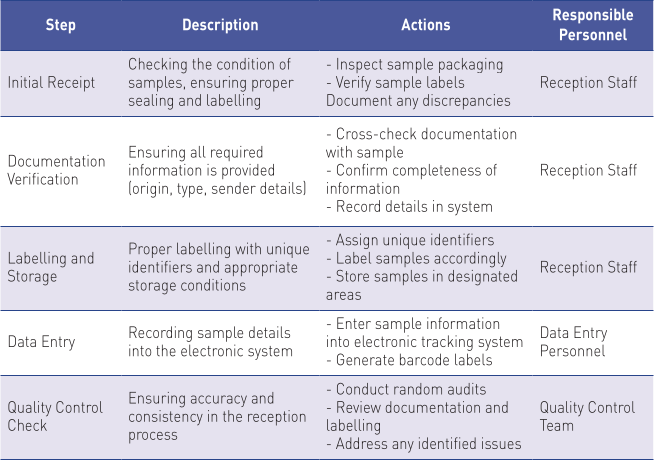
It is important to have a standardised procedure in place to ensure consistency and accuracy (MDS, 2025). The initial receipt of samples involves checking the condition of the samples and ensuring that they are properly sealed and labelled. Any discrepancies or issues with the samples should be documented and addressed immediately (Smith, 2020). Verification of accompanying documentation is a critical step in the sample reception process. This includes checking that all required information is provided, such as the sample’s origin, type, and any relevant information provided by the sender. Proper documentation ensures the traceability and integrity of samples, which is essential for accurate testing and analysis (Williams, 2018). Proper labelling and storage of samples are also crucial to maintain their integrity. Samples should be labelled with unique identifiers and stored in appropriate conditions to prevent contamination or degradation. The use of electronic tracking systems can help ensure that samples are accurately tracked from receipt to analysis, reducing the risk of misplacement or loss (Kubáňová et al., 2022).
Documentation
Accurate documentation is critical for the traceability and integrity of samples. This includes recording the sample’s origin, type, and any relevant information provided by the sender. The use of electronic documentation systems can help streamline this process and reduce the risk of errors (Williams, 2018).
Electronic documentation systems allow for the efficient recording and retrieval of information, reducing the risk of errors associated with manual documentation (Smith, 2020). In addition to recording the sample’s origin and type, it is important to document any relevant information provided by the sender. This may include details about sample collection, handling, or storage conditions. Proper documentation ensures that all relevant information is available for analysis, which is essential for accurate testing and interpretation of results (MDS, 2025).
Technology in Sample Reception
The implementation of technology (Table 2), such as barcode scanning and electronic tracking systems, can greatly improve the efficiency of the sample reception process.
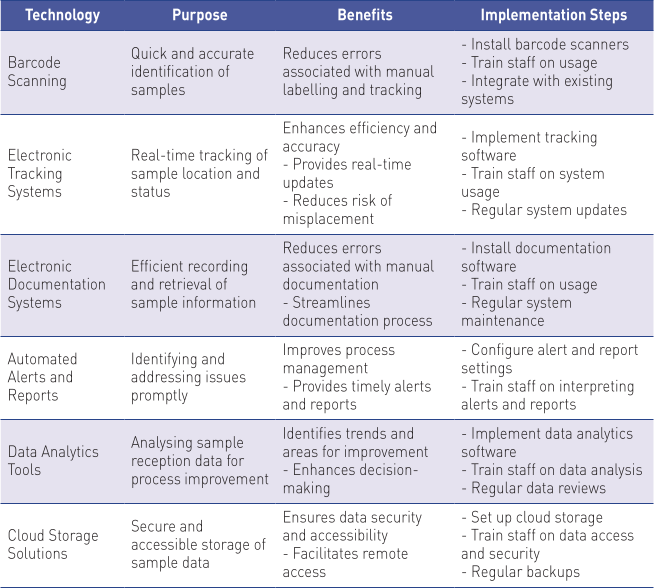
These tools help ensure that samples are accurately tracked from receipt to analysis, reducing the risk of misplacement or loss (Kubáňová et al., 2022). Barcode scanning technology allows for the quick and accurate identification of samples, reducing the risk of errors associated with manual labelling and tracking (Williams, 2018). Electronic tracking systems provide real-time information about the location and status of samples, allowing for efficient management of the sample reception process. These systems can also generate reports and alerts, helping to identify and address any issues that may arise (Smith, 2020). The use of technology in sample reception not only improves efficiency but also enhances the accuracy and reliability of the process (Kubáňová et al., 2022).
Quality Control
Quality control measures (Table 3) are essential to maintain the integrity of samples and the accuracy of test results.
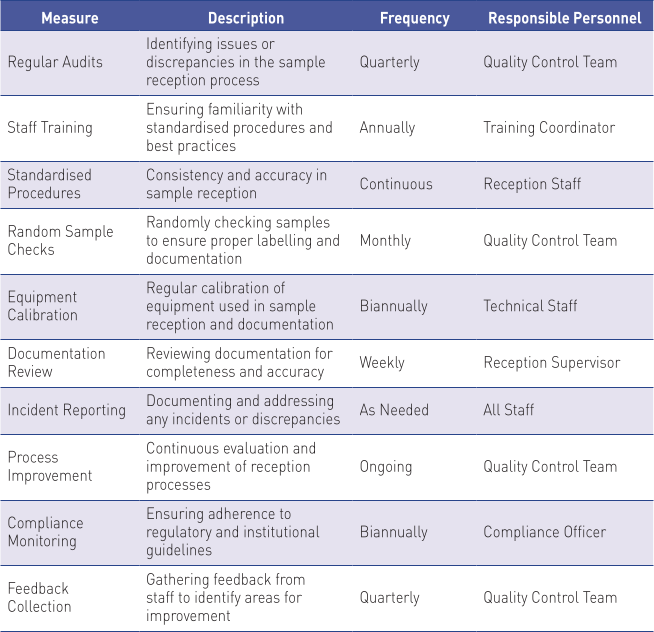
This includes regular audits of the reception process, staff training, and the use of standardised procedures (WHO, 1996). Regular audits help identify any issues or discrepancies in the sample reception process, allowing for timely corrective actions (Smith, 2020). Staff training is also crucial to ensure that all employees are familiar with the standardised procedures and best practices for sample reception.
Training programmes should be regularly updated to reflect any changes in procedures or technology (MDS, 2025). The use of standardised procedures ensures consistency and accuracy in the sample reception process, reducing the risk of errors and improving the reliability of test results (Williams, 2018).
Conclusion
The reception office at the Croatian Veterinary Institute, Zagreb, Croatia plays a vital role in ensuring the accurate and efficient handling of samples and accompanying documentation. By implementing best practices, utilising technology, and maintaining strict quality control measures, the institute can ensure the integrity of its testing processes and contribute to public health and safety. Proper sample reception and documentation are critical for maintaining the traceability and integrity of samples, which directly impacts the accuracy and reliability of test results. The use of technology, such as electronic documentation systems and barcode scanning, can significantly enhance the efficiency and accuracy of the sample reception process. Additionally, implementing quality control measures, including regular audits and staff training, ensures the reliability and consistency of the reception process. By adopting these best practices, the Croatian Veterinary Institute can improve its operational efficiency and reduce the risk of errors, thereby contributing to public health and safety.
References [… show]
Učinkovito upravljanje prijemom uzoraka i dokumentacijom u Hrvatskom veterinarskom institutu, Zagreb, Hrvatska
Darko ŽELJEŽIĆ, dr. med. vet., stručni savjetnik, Hrvatski veterinarski institut, Zagreb, Hrvatska
Prijemni ured u Hrvatskom veterinarskom institutu, Zagreb, Hrvatska ima ključnu ulogu u osiguravanju točnog i učinkovitog rukovanja uzorcima i pratećom dokumentacijom. Ovaj rad opisuje najbolje prakse za upravljanje prijemom uzoraka, naglašavajući važnost pravilne dokumentacije, korištenje tehnologije za pojednostavljenje procesa i implementaciju mjera kontrole kvalitete. Pravilna dokumentacija je ključna za održavanje sljedivosti i integriteta uzoraka, što je kritično za točno testiranje i analizu. Korištenje tehnologije, kao što su sustavi elektroničke dokumentacije i skeniranje barkodova, može znatno poboljšati učinkovitost i točnost procesa prijema uzoraka. Osim toga, implementacija mjera kontrole kvalitete, uključujući redovite revizije i obuku osoblja, osigurava pouzdanost i dosljednost procesa prijema. Usvajanjem ovih najboljih praksi, Hrvatski veterinarski institut Zagreb, Hrvatska može poboljšati svoju operativnu učinkovitost, smanjiti rizik od pogrešaka i doprinijeti javnom zdravlju i sigurnosti.
Ključne riječi: prijem uzoraka, dokumentacija, Hrvatski veterinarski institut, kontrola kvalitete, tehnologija
